
A garage door that grinds, bangs, or squeals every time it opens isn't just annoying — it's telling you something is wearing out. Ignore it through one more Franklin Square winter and that "something" usually turns into a snapped cable, a stripped opener gear, or a spring that lets go on a sub-freezing morning when you least want to be dealing with it. The freeze-thaw cycles, road salt tracked in on tires, and decades-old original hardware common in this part of Nassau County all accelerate wear that starts out as a simple squeak. The good news: most noise problems are cheap and quick to fix if you catch them early, and the ones that aren't are worth knowing about before they become emergencies.
Step-by-Step: Quieting Your Garage Door Opener
Tools you'll need
- Socket wrench or adjustable wrench
- Garage door-specific lithium or silicone-based lubricant (not WD-40 or motor oil)
- Rag or shop towel
- Step ladder
- Replacement nylon rollers (if needed)
- Rubber anti-vibration isolator pads (if needed)
Step 1: Tighten every bolt and bracket
Start with the door closed and power to the opener disconnected. Walk the track, hinges, and roller brackets with a socket wrench and snug up anything loose. Vibration from daily use — plus the expansion and contraction older doors go through with seasonal temperature swings — works bolts loose over time. This alone eliminates a surprising amount of rattle.
Step 2: Lubricate the moving parts
Apply lubricant to the hinges, rollers (the metal part, not the nylon roller itself), the track, and the opener's drive screw or chain. Do this every six months, and definitely before winter — humid summers followed by cold, dry winters cause metal parts to gum up with old grease and grit, which shows up as grinding and squealing.
Step 3: Inspect and replace worn rollers
Look at each roller as the door moves. Cracked, flat-spotted, or chipped nylon rollers are a common noise source on older doors and are inexpensive to swap out yourself — pull the retaining bracket, slide the old roller off the track, and install the new one. If a roller is metal with exposed ball bearings and it's grinding, that's a sign of age consistent with original hardware many Franklin Square homes still have.
Step 4: Add vibration isolation to the opener
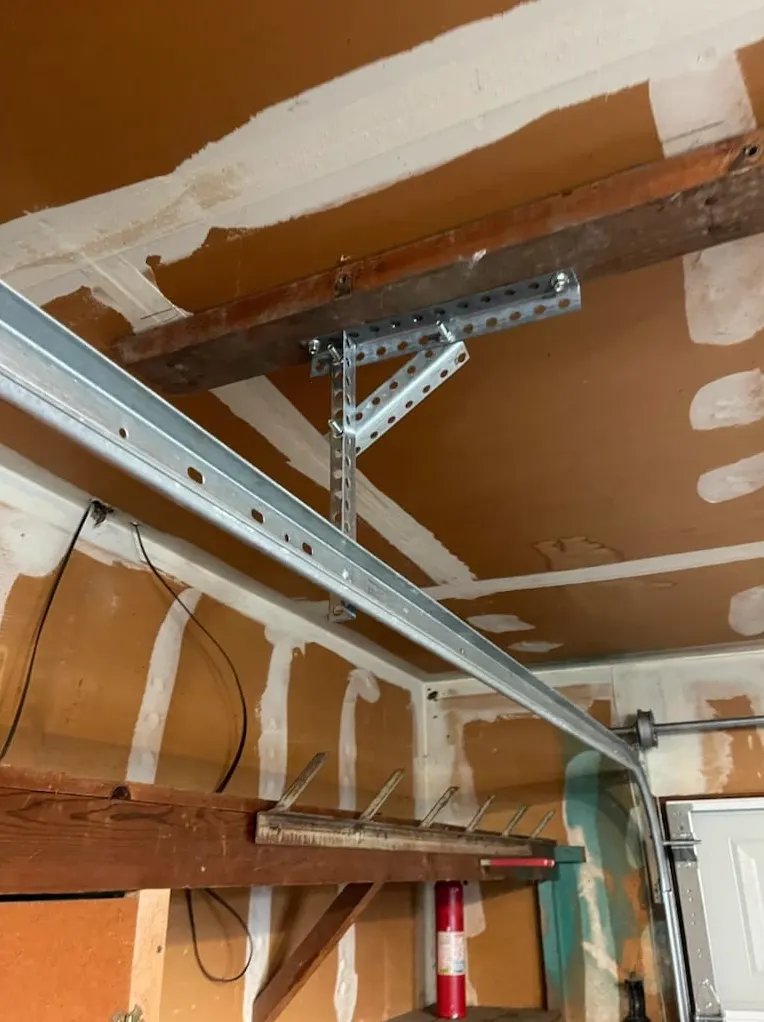
If the noise sounds like it's coming through the ceiling and into the house, the opener's motor unit may be bolted directly to a rafter with no buffer. Rubber isolator pads between the mounting bracket and the ceiling joist absorb vibration before it travels. This is a 20-minute job with a ladder and a wrench.
Step 5: Check hinges for stretched screw holes
On doors with years of flexing — especially after repeated slamming from wind during nor'easters — hinge screw holes can wallow out, letting the hinge rattle even when "tightened." If the screw just spins, the hole needs a slightly larger screw or a wood/metal filler before it will hold. This is still homeowner-doable but takes patience.
What's a DIY Fix vs. What Needs a Technician
Safe for homeowners: tightening hardware, lubrication, swapping nylon rollers, adding vibration pads, replacing hinge screws.
Call a technician for:
- Any noise that seems to come from the springs or a visibly stretched, rusted, or gapped spring coil — these are under extreme tension and not a DIY repair
- Frayed or fraying lift cables
- A door that's noisy on one side only, which often points to track misalignment
- Grinding from inside the opener housing itself, which usually means worn internal gears
- A chain-drive opener you want converted to a quieter belt-drive system
The Bigger Fix: Belt-Drive Conversion
If you've done all the cheap fixes and the opener itself is still loud — not the door, the motor unit — the root cause is often an aging chain-drive mechanism. Chain drives are reliable but mechanically noisy by design, especially once the chain stretches slightly with age, which happens faster with the temperature swings typical of our winters. A belt-drive opener uses a reinforced rubber belt instead of a metal chain and runs dramatically quieter — a real difference if the garage sits under a bedroom. This isn't a bolt-on part; it's a full opener swap, including re-mounting the rail, motor head, and safety sensors, and it's worth having done professionally to make sure the travel limits and auto-reverse safety features are calibrated correctly afterward.
When to Call Franklin Square Garage Door Experts
If you've tightened, lubricated, and padded everything and the door is still noisy — or if you've spotted a cable fraying, a spring that looks stretched or rusted, or hinges that won't hold a screw — it's time to bring in a technician rather than keep troubleshooting. Our Garage Door Maintenance service covers a full inspection of springs, cables, rollers, and hardware so small issues get caught before they turn into a weekend without a working garage door. If the fix really is the opener itself, our Garage Door Opener Repair & Installation service includes belt-drive conversions, done with the correct safety calibration from the start.
If you're in Franklin Square, Elmont, Floral Park, New Hyde Park, Garden City, Hempstead, West Hempstead, or Valley Stream and your garage door has been getting louder by the week, call Franklin Square Garage Door Experts before the first hard freeze puts extra strain on worn parts. We'll track down the actual source of the noise and fix it right the first time.